Commercial · Gladstone, MO
ADA concrete contractor in Gladstone, MO — accessible ramps, walkways, and entries.
ADA concrete requires slope tolerances, surface textures, and transition details that standard flatwork doesn't address — running slopes can't exceed 1:12, cross-slopes can't exceed 1:48, and detectable warning surfaces must go in specific locations, all verified before and after the pour. We install ADA-compliant ramps, accessible walkways, and detectable warning surfaces for commercial and institutional properties across north Kansas City.
Free Estimate
Tell us about your project
We respond within one business day.
The Finished Result
Accessible routes that meet compliance requirements and remain functional over time.
ADA accessible concrete is about more than slope compliance at installation — it's about maintaining that compliance as the concrete ages. Frost heave, clay settlement, and surface deterioration can all compromise accessible routes over time. Proper installation addresses the factors that create non-compliance over a concrete surface's service life.
Request Free Estimate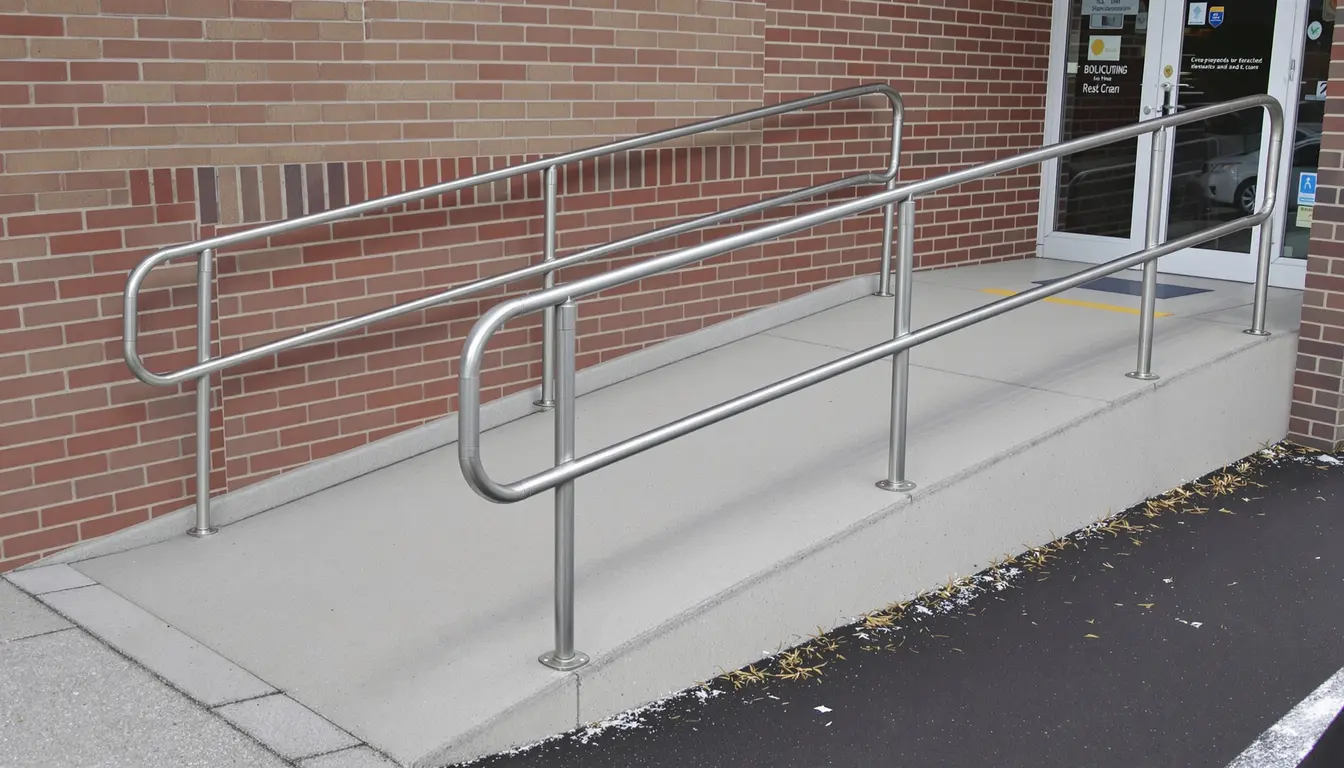
Service Overview
What ADA concrete work includes
ADA concrete encompasses curb ramps at street crossings, accessible building entry ramps, accessible walkway connections, detectable warning surfaces (truncated dome pads), accessible parking areas with appropriate slopes, and transitions between different surface materials that must meet accessibility requirements.
The technical requirements for ADA concrete are specific: maximum running slopes, maximum cross-slopes, minimum clear widths, level landing areas at grade transitions, and specific surface texture requirements for detectable warnings. We work within these requirements on every ADA project.
Common reasons for this service
- Curb ramps at street crossings. New or replacement concrete curb ramps at public or private street crossings — bringing them into ADA compliance with current standards.
- Commercial entry ramps. Accessible ramps at building entrances where steps exist without an accessible alternative route.
- Detectable warning surfaces. Installing or replacing truncated dome detectable warning pads at curb ramps, hazardous vehicle ways, and transit platforms.
- Accessible parking area improvements. Pouring or upgrading designated accessible parking spaces and access aisles to current slope and dimension requirements.
- Accessible walkway connections. Creating or repairing accessible routes between parking, building entrances, and site amenities.
- Municipal and institutional projects. Municipal sidewalk and curb ramp improvements, school and institutional accessible route projects.
What Matters
The technical factors that determine whether this project lasts.
These aren't variables that show up on a finished surface — they're what's underneath it.
Running slope tolerance (max 1:12)
The running slope of an accessible ramp cannot exceed 1:12 (8.33%). Exceeding this creates a non-compliant ramp regardless of other factors. Grade changes must be carefully planned.
Cross-slope tolerance (max 1:48)
The cross-slope of an accessible path cannot exceed 1:48 (2%) in most applications. This is tight — requiring careful forming and finishing.
Level landings at grade changes
Level landing areas (max 1:48 slope) are required at the top and bottom of each ramp run, and at every change of direction.
Detectable warning surfaces
Truncated dome surfaces are required at the base of curb ramps, at hazardous vehicle ways, and at transit boarding platforms. The dome spacing and size are specified by ADA standards.
Surface texture for traction
Accessible surfaces require a stable, firm, slip-resistant texture. Broom finish is appropriate for most accessible concrete. Smooth finishes are not appropriate.
North KC Conditions
How Gladstone's soil and climate affect ada concrete.
Frost heave affects accessible routes
Frost heave from north KC's clay soil can shift accessible route elevations, creating slope non-compliance and hazardous surface discontinuities. Base preparation depth is critical for ADA concrete.
Deicer use on accessible routes
Accessible routes require winter maintenance — but deicer use accelerates concrete surface deterioration. Sand is a better traction option where accessible surface durability matters.
Seasonal maintenance requirements
Accessible routes require clear, stable surfaces year-round. Winter maintenance planning is part of ADA compliance — snow removal and ice management can't create surface conditions that block accessible access.
The Process
From your first call to the finished project.
Request an estimate
Describe the project — building entrance, curb ramp, parking area, walkway connection. Note any existing non-compliance conditions.
Site assessment
We measure existing grades, assess what ADA compliance requires at the specific location, and identify what concrete work is needed.
Scope development
Written estimate specifying the accessible route design, slopes, dimensions, detectable warning locations, and fixed price.
Forming to compliance tolerances
Forms are set to the tight slope tolerances required by ADA standards — measured and verified before the pour.
Pour, finish, and inspection
Concrete placed, broom-finished, detectable warning surfaces installed at required locations. Slopes verified after finishing.
FAQ
Common questions about ada concrete in Gladstone, MO.
What slope is required for an ADA ramp?
The maximum running slope for an accessible ramp is 1:12 — one inch of rise for every 12 inches of horizontal run (8.33%). Steeper slopes are not compliant regardless of handrail or edge protection. The maximum cross-slope is 1:48 (2.08%). These are federal ADA standards that apply to both new construction and alterations.
What are detectable warning surfaces?
Detectable warning surfaces are truncated dome patterns (raised dots) in a specific grid pattern and color contrast — typically yellow on gray concrete. They are required at the base of curb ramps to alert people with visual impairments to the presence of a hazardous vehicle way. The dome size, spacing, and base dimensions are specified by ADA standards.
How do I know if my property needs ADA updates to the concrete?
If your property has public accommodations (open to customers or clients), you have ongoing obligations to make accessible routes. Curb ramps, building entry ramps, accessible parking, and connecting walkways are common compliance issues. An assessment at the site visit will identify what the existing conditions are and what's needed to bring them into compliance.
Can existing concrete ramps or walkways be modified to meet ADA requirements?
Sometimes, depending on how far out of compliance the existing concrete is. Minor slope corrections or detectable warning surface additions may be possible. More significant slope problems usually require removal and repour — you can't grind a ramp into compliance without addressing the grade change that's causing the slope problem.
Do you handle permit applications for ADA work?
Permit requirements for ADA concrete work vary by jurisdiction and project type. We handle the concrete work — permit coordination is typically the property owner or general contractor's responsibility, though we can assist with technical questions about what the project involves.
Serving north Kansas City
Ready to discuss your ADA concrete project?
Free estimates for ada concrete across Gladstone and north Kansas City.